


MS
Magnetron Sputtering

Magnetron Sputtering (MS) uses a magnetron plasma for sputtering a metal layer on the substrates and oxidizing it to a stoichiometric metal-oxide in a microwave plasma afterwards. This technique allows to produce very dense and hard coatings.
In the coating machine a drum with a diameter of 120 cm holds the substrates. It rotates vertically in front of the two magnetrons and microwaves.
A plasma of ionized argon forms in front of the target. The positively charged argon ions are accelerated toward the negatively charged target, where they strike the face of the target and sputter metal atoms on the substrates.
Rotating into the microwave plasma the metal film is oxidized and ready for the next cycle.
The coatings are very hard and mechanically resistant and can work in nearly every environment. Specific coatings are space certified by ESA.
Two different material targets can be used in one configuration. The sputter rates are very stable, so the thickness control is done with high precision simply by time and with an optical monitor as backup. Especially for UV-coatings and cw-applications very high LIDT can be achieved.
As the process works with low temperatures coatings on plastic or other non-glasslike materials (e.g. fiber ends) are possible.
Like all sputter techniques, coatings made by MS may have high stress, depending on the wavelength region and coating materials used.
Pros and cons of MS
+ Very dense and hard
coatings
+ Space certified by ESA
+ High precision
+ High LIDT for UV-coatings
and cw
+ Low temperature coatings
– Compressive stress (case
dependent)
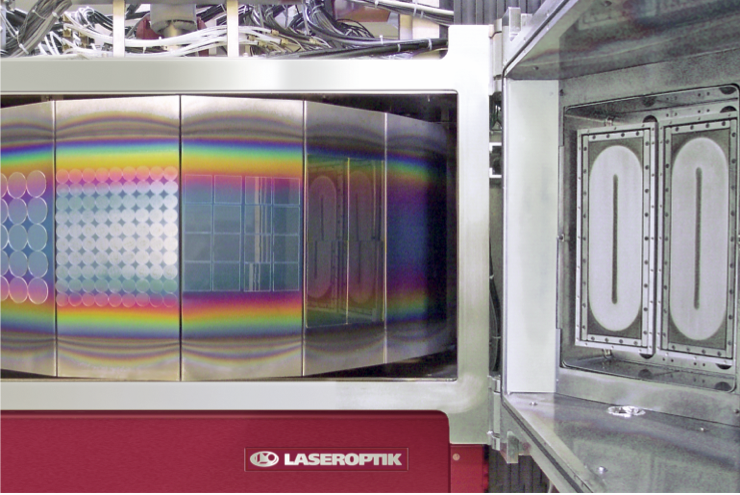
Magnetron sputter coating machine

“Sola” is a HELIOS 800 – a turntable magnetron sputter deposition machine for PARMS
Ramping up volume production whilst remaining competitive can be challenging when creating sophisticated laser optics. To address this need, LASEROPTIK has invested in a highly automated magnetron sputtering system for the serial production of designs such as
– Complex filters
– Multiline coatings
– Precise AR and HR coatings
Our “Sola” is a HELIOS 800 (from Bühler Leybold Optics), which is a turntable magnetron sputter deposition machine for plasma assisted reactive sputtering (PARMS) of optical filter stacks consisting of up to 1000 dielectric layers. It can also co-sputter variable refractive index layers.
For standard sizes like Ø 25 mm, this coating machine has several times the capacity of our standard PVD machines. It can handle up to five-digit annual volumes thanks to its automated substrate loading and unloading modules with three load locks for increased productivity and low defect levels.
As you will expect from a superior sputtering system, these coatings are hard, durable, environmentally stable and can even be heat, acid and radiation resistant.
Furthermore, “Sola” provides high precision and reproducible results. LASEROPTIK’s broadband in-situ optical monitoring system ensures a run-to-run thickness reproducibility of ±0.1% for thick layer stacks and enables precise deposition control for thin layers of < 5 nm.
R&D products can be transferred to reliable serial production with a competitive advantage in terms of volume pricing and feasibility, thanks to “Sola's” advanced capacity and automated overnight operation.
