


GTI mirrors
 GTI mirrors are basically Bragg mirrors with added and precisely adjusted spacer layers in the upper section of the film stack which work like a Gires-Tournois-Interferometer (GTI).
Resonances introduced by the spacer layers can produce very high GDD values but these are limited: The higher the GDD, the smaller the spectral bandwidth (see curves of three different GTI mirrors on the right).
LASEROPTIK offers GTI mirrors with GDD values up to about 5000 fs². Even higher values are possible but will lead to increased optical losses and lower LIDT.
GTI mirrors may be equipped with additional features like a pass band for the pump laser or a tailored transmittance, so they can be used as out-coupling mirrors. A typical application is the dispersion management in Ytterbium based lasers.
Examples
If not mentioned otherwise, all values and diagrams are given
... for the standard substrate material used in the described wavelength area (mostly Fused Silica or CaF2).
... without consideration of the rear surface.
... with EBE coating technique for a good cost-performance ratio.
Customized coatings are available for all types.
–––– dashed lines show the zoomed curve with the stated magnification
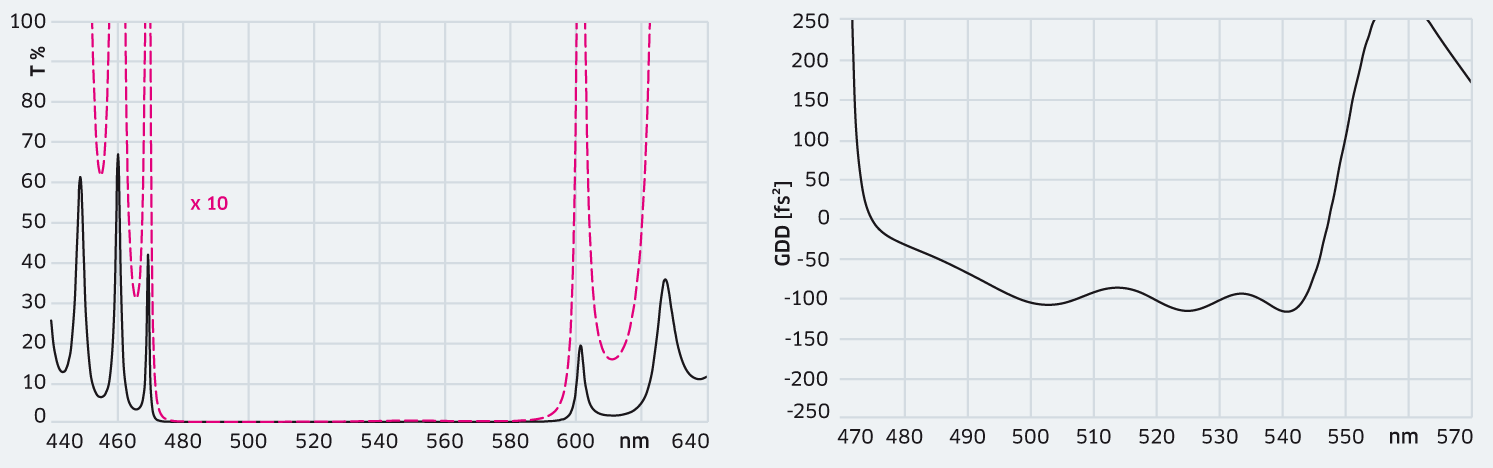
490–540 nm: Rs > 99.9%; GD(Rs) ±2 fs vs. design + const. (IBS-coating)
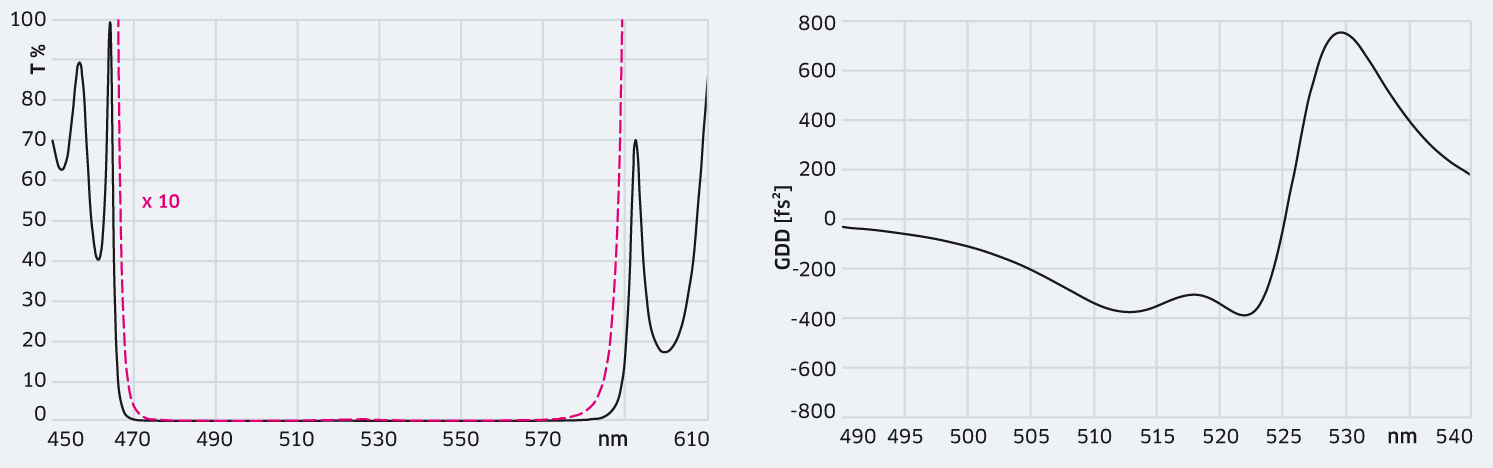
502–522 nm: Rs > 99.8%; GD(Rs) ±3 fs vs. design + const. (IBS-coating)
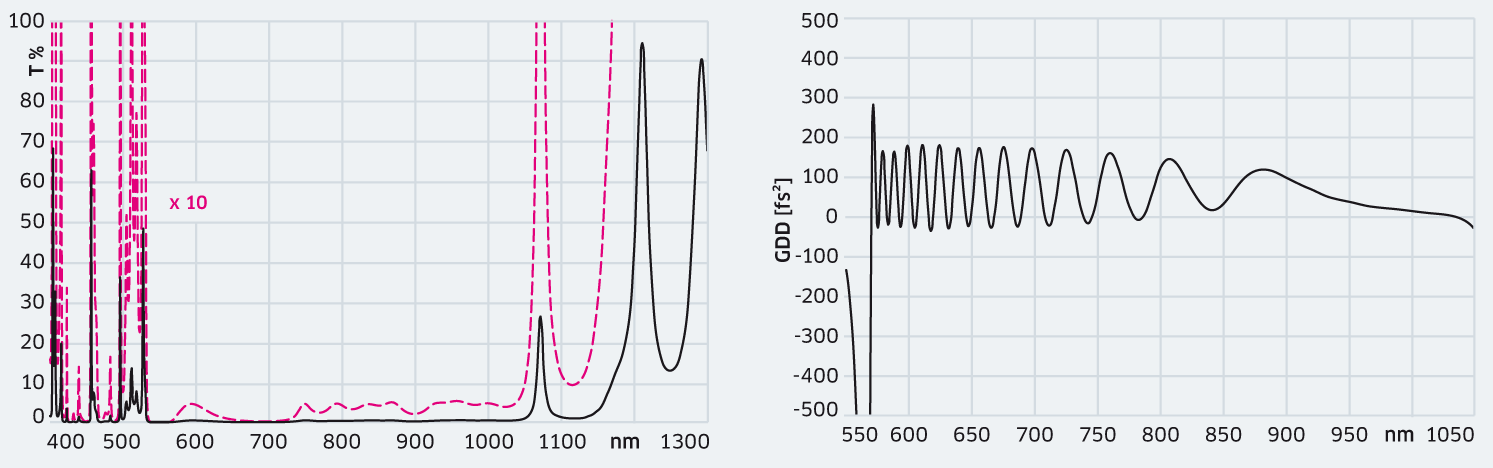
With the high accuracy of the IBS coating technique, we produce GTI mirrors which are optimized for the GDD but also compensate for the dispersion of other optics within the beam path. GDD targets can be set precisely for every material and specific thickness. The shown coating is optimized for a 3.5 mm thick Ti:Sapphire within the path:
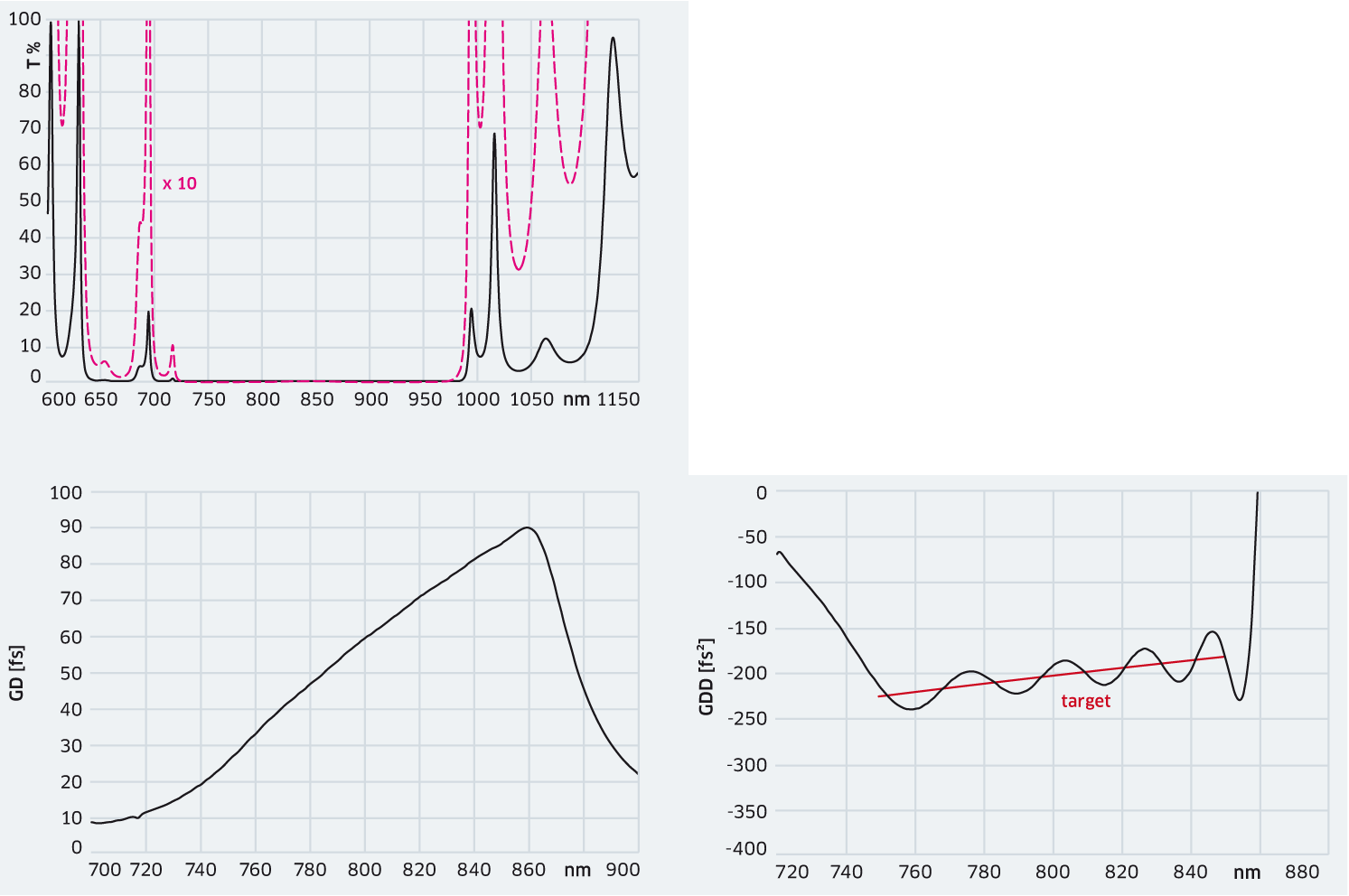
750-850 nm: Rp > 99.9%; GD(Rp) ±4 fs vs. design + const. (IBS-coating)

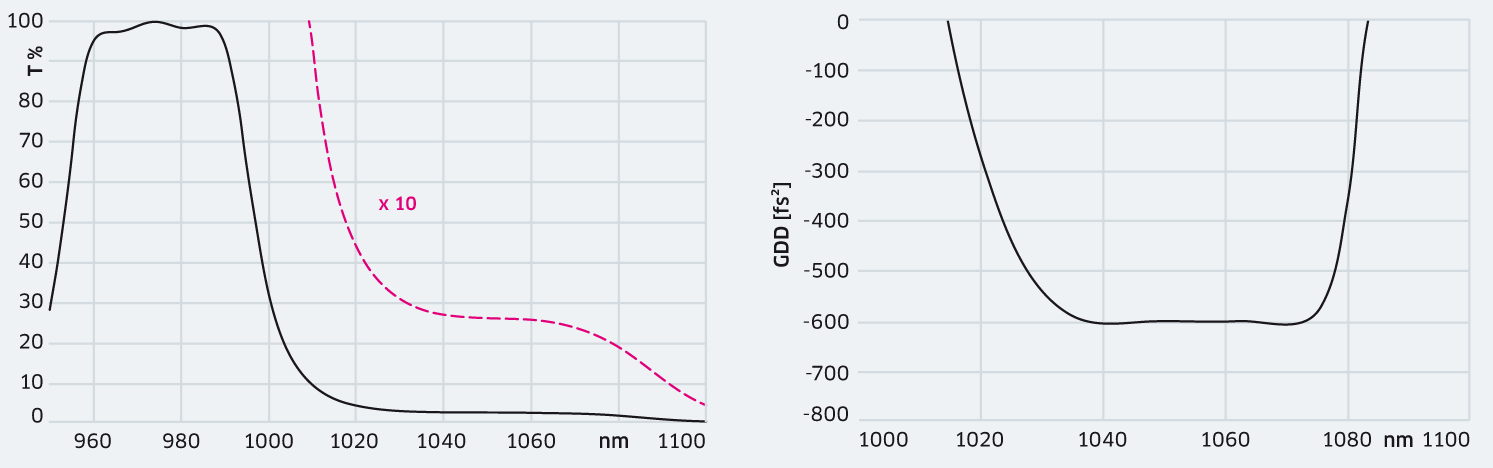
980 nm: T > 95%; 1055 nm ±8 nm: R ±0.25%, GDD ±60 fs² (IBS-coating)
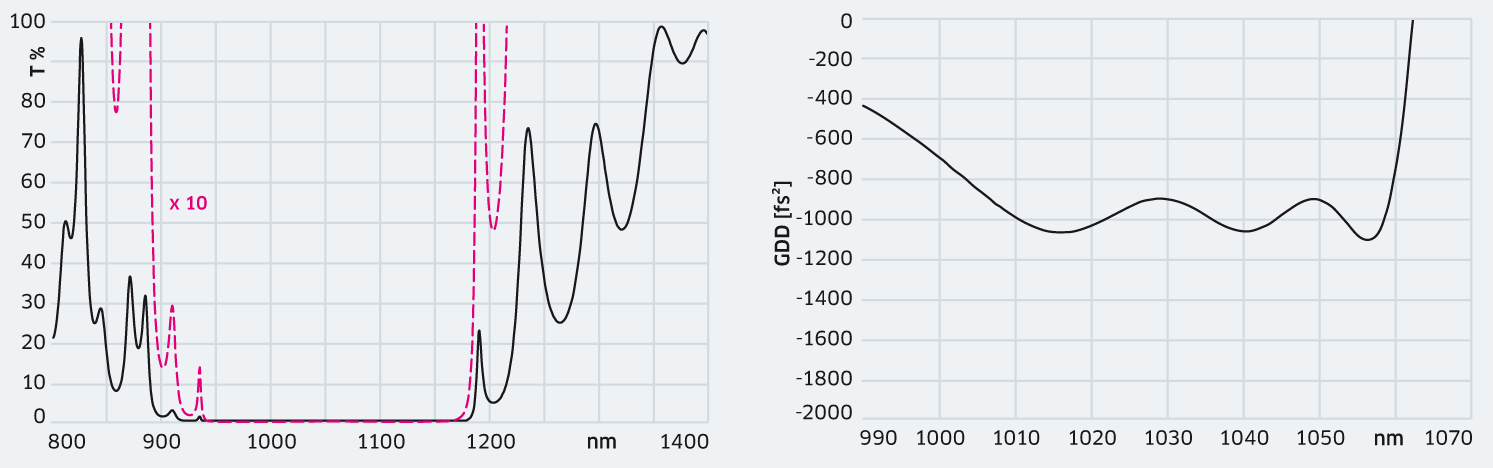
1010–1050 nm: Rp > 99.9%; GD(Rp) ±8 fs vs. design + const. (IBS-coating)

976 nm: T > 95%; 1030 nm: T ±1%, GDD ±250 fs² (IBS-coating)

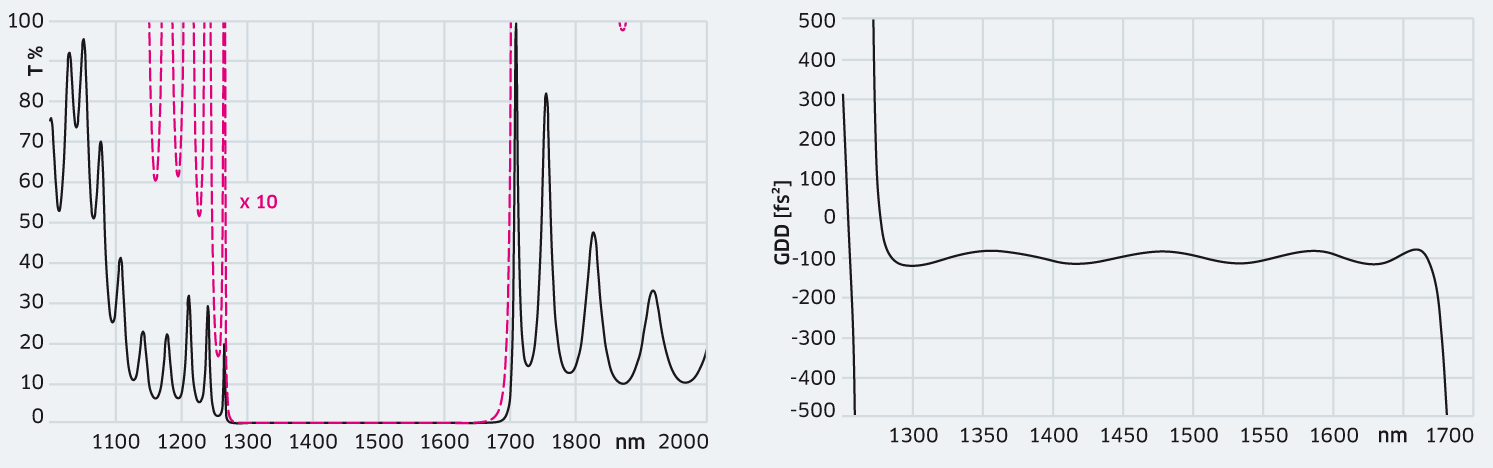
1290–1650 nm: R > 99.9% (goal R > 99.95%); 1305–1640 nm: GDD(R) ±45 fs² (IBS-coating)
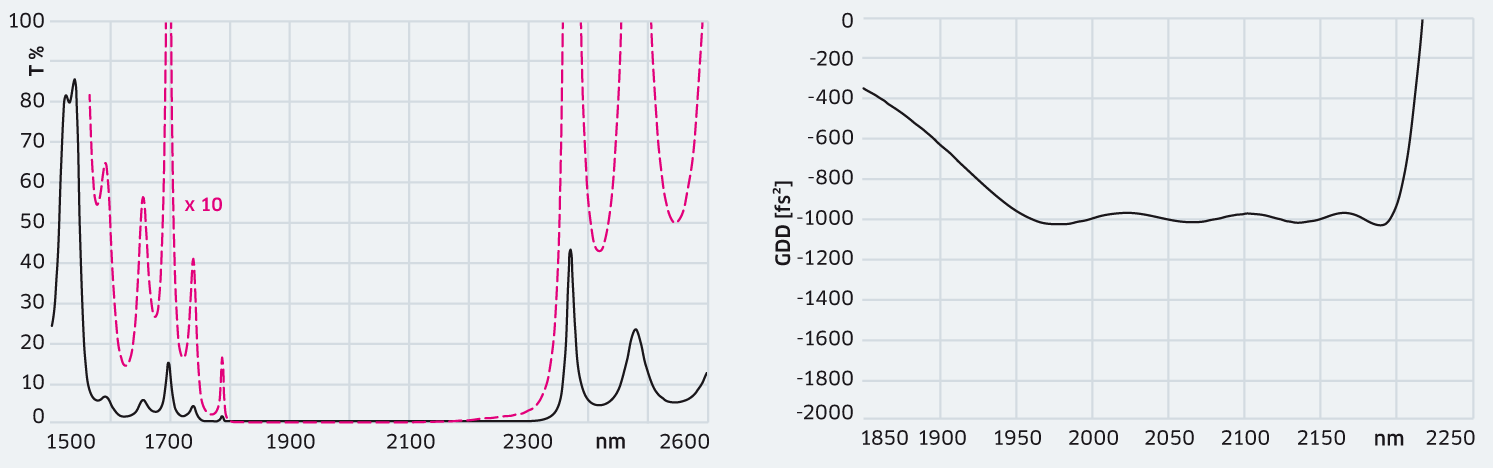
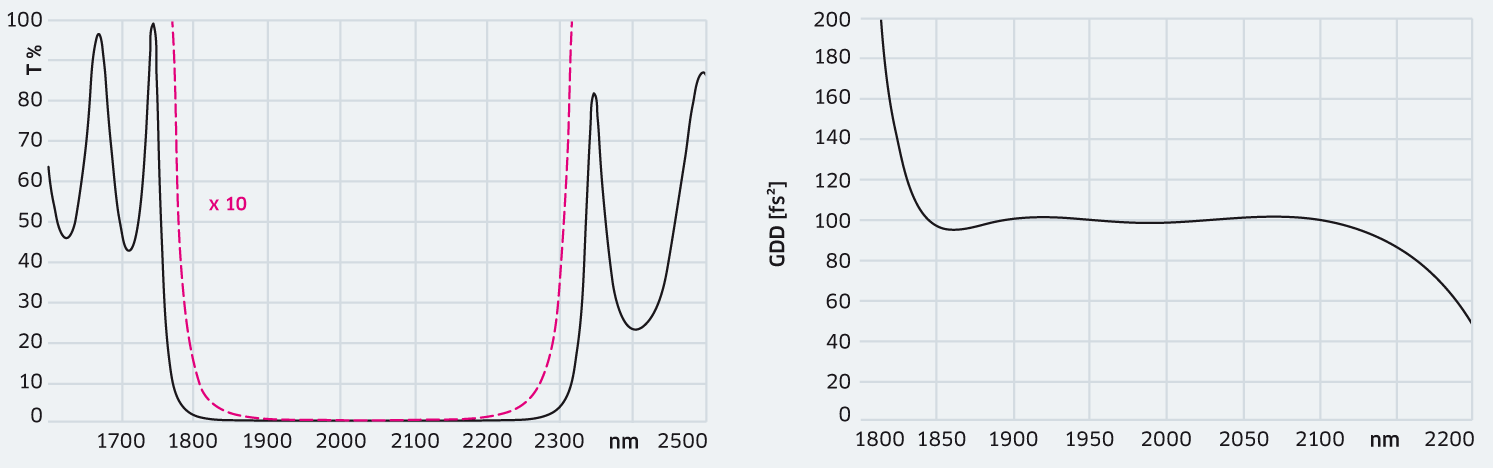
1820–2130 nm: Rp > 99.9%; 1820–2200 nm: R > 99.8%; 1960–2180 nm: GDD(Rp) ±350 fs² (IBS-coating)
Every coating type can be optimized
for every
• substrate material
• wavelength
• reflection/transmis-
sion value
• angle of incidence
• polarization
• GDD value
• ...
Alternatively we can create
a totally new design for you.
