Large optics
LASEROPTIK uses dedicated equipment for dielectric coatings on large optics up to 2 m in length (long axis for rectangular shapes) or 550 mm in diameter with a superior spectral uniformity over the complete surface and high LIDT values. Approved automated ultrasonic and manual cleaning procedures guarantee an optimum cleanliness even on these large scale geometries. The possible sizes are listed in the table below.
| coating technique | rectangular | round | |
|---|---|---|---|
| long axis | short axis* | Ø | |
| IBS | 2000 mm | 250 mm | 550 mm |
| EBE | 1200 mm | 100 mm | 500 mm |
*at the given maximum of the long axis, can be larger with a shorter long axis.
The uniformity of the coatings is a critical factor for applications in industrial lasers, e.g. for laser beam expansion and delivery systems. Coating design, inner architecture of the machine and in-situ process control help to reduce gradient effects to a minimum. The uniformity can also be adapted to the radii of curvature, for example with cylindrical lenses.

Long shapes
For long bar-shaped substrates, plane or curved, LASEROPTIK can coat laser mirrors that are amongst the largest in the world (up to 2000 mm in length) by using Ion Beam Sputtering (IBS). This method is commonly known for producing the highest quality thin films, but just on small areas. However, by redefining an advanced substrate motion, an unique approach for long optics was found and has been patented. Currently two custom-built machines are working to offer this unique process.
A variance in central wavelength of below ±1% can be achieved for optics up to 2000 mm in length. The 8 measured curves below show the excellent uniformity on a large optic (long axis > 1300 mm) which is coated with an IBS broadband AR.
“Maxima”, the patented IBS coating machine for large optics (long shapes)

Round shapes
As with long substrates, round optics can be coated by IAD and EBE if the coating requirements are standard. When it comes to complex coating designs and superior spectral performance, IBS coatings offer adequate solutions. LASEROPTIK has commercial coating systems for substrates up to Ø 400 mm and custom-built machines for up to Ø 550 mm in operation, or adequately for rectangular shapes fitting onto the carrier planet.
These specialized machines also allow the use of three or more coating materials, which is important for advanced thin-film design strategies aiming at the highest LIDT. This capability is crucial for very high energy laser research, also known as petawatt and laser fusion projects. Another common use of large round optics is gravitational wave research. The detector’s sensitivity is dependent on the end mirrors’ perfection, i.e. the total losses and Brownian noise have to be reduced to a minimum. IBS is well suited to this task as its low loss coatings are approved by gyroscope applications (see some values here).
Tailored environment of separate cleanrooms with a dedicated inspection metrology, optic cleaning and annealing solutions was built to support this innovative equipment. It is part of a department that specializes in working with large round and rectangular optics, addressing the highest demands for LIDT, low losses and spectral performance.
A space-resolved quality inspection is performed on the whole dimension to check for surface defects and spectral properties, including interferometric inspection. Large optics are held in custom-built lifting and handling tools for inspection, transportation and fixing in the coating machine.
“Teresa”, the largest IBS machine, suitable for substrates up to Ø 550 mm

With our unique large-optics IBS coating machines we have produced many complex coatings on challenging substrate sizes. The confidentiality of information about our customers, their products and technologies are important to us. Here are some applications we are allowed to mention.
Ultrafast mirrors for petawatt laser beamlines
Latest advances in petawatt laser technology have stimulated the development of large surface area, dielectrically coated mirrors to guide these demanding ultrashort pulse laser beams.
The ELI Beamlines user facility located in the Czech Republic provides access to high average power petawatt laser technology for basic science and multidisciplinary applications. The high-repetition-rate, advanced petawatt laser system HAPLS is a Ti:Sapphire system and was built at Lawrence Livermore National Laboratory (LLNL). It is designed for a repetition rate of 10 Hz.
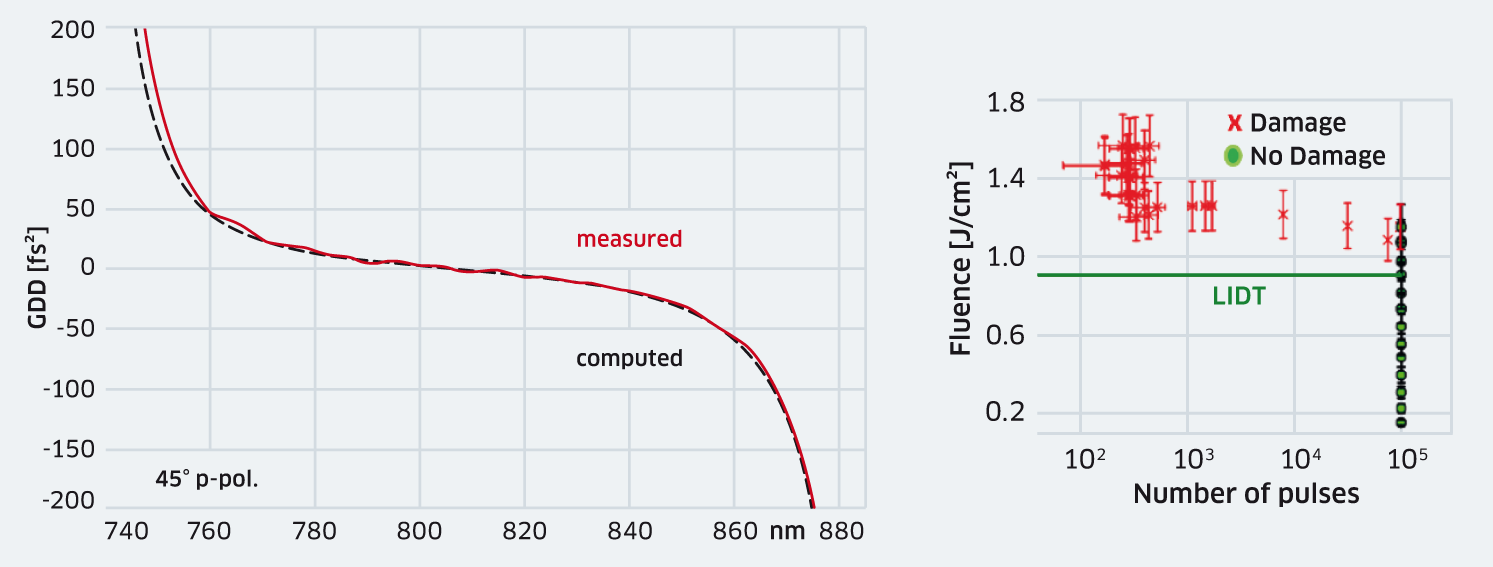
Consequently, the primary challenge of the HAPLS beam transport mirror coating design is to achieve the highest possible laser induced damage threshold while meeting the requirements for reflectivity (Rp ≥ 99.8%), group delay dispersion (|GDD(Rp)| ≤ 50 fs²) and bandwidth (80 nm for p-polarization) at an angle of incidence of 45°.
The LIDT of the large-sized optics (440 x 290 x 75 mm³) is expected to be decreased by target debris and local intensity spikes. The dielectric mirrors therefore require the highest possible LIDT margin to provide for a long lifetime and reliable operation.
Extensive design studies were performed, and the different deposited optics were tested at a dedicated LIDT test set-up according to the ISO 21254-2 S-on-1 test protocol with 42 fs pulses and a repetition rate of 1 kHz at ELI beamlines. The number of pulses per site is set to S = 100,000. A LIDT of 0.9 J/cm² (sample surface) could be demonstrated and the beam normal fluence is about 1.27 J/cm². Such a LIDT-optimized design with a spectral width of 95 nm in the case of p-polarized light and 170 nm for s-polarized light is a major advantage compared to conventional e-beam coated mirrors.
These results play a major role for the next generation of required large optical coatings for PW applications, which is also investigated in the funded PriFUSIO project, see next chapter
Further reading:
Thomas Willemsen, Uddhab Chaulagain, Irena Havlíčková, Stefan Borneis, Wolfgang Ebert, Henrik Ehlers, Melanie Gauch, Tobias Groß, Daniel Kramer, Tomáš Laštovička, Jaroslav Nejdl, Bedřich Rus, Konrad Schrader, Tomas Tolenis, František Vaněk, Praveen K. Velpula, and Stefan Weber: Large area ion beam sputtered dielectric ultrafast mirrors for petawatt laser beamlines, Opt. Express 30, 6129-6141 (2022)
Cutting-edge technology for climate-neutral fusion power plants
LASEROPTIK is one of ten selected partners in the national PriFUSIO research project, which was initiated by the German Federal Ministry of Education and Research (BMBF) and will be funded with 15.5 million euros over three years. PriFUSIO, led by the Fraunhofer Institute for Laser Technology (ILT, Aachen Germany), aims to develop key technologies for future-oriented, climate-neutral fusion power plants.
When it will be made commercially viable, laser-driven inertial fusion energy (IFE) will offer clean and safe energy generation 24/7. One gram of fusion fuel can generate as much energy as burning eleven tons of coal – without producing long-lived, highly radioactive waste and being completely safe from nuclear meltdowns.
Complex dielectric broadband mirrors for astronomy applications (astro combs)
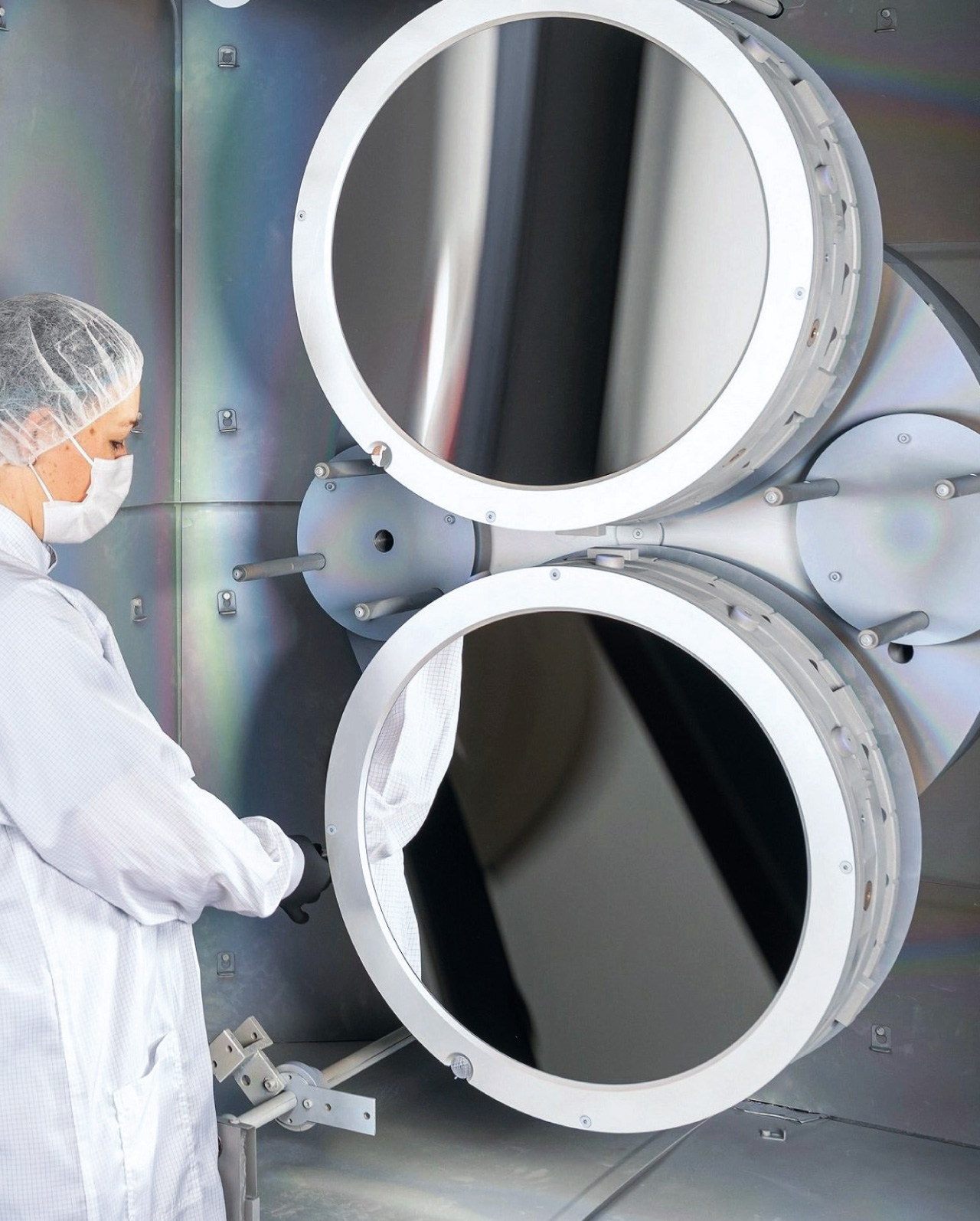
It was a major challenge in coating: With a diameter of 520 mm and a weight of each 35 kg, the two depicted optics were guest stars in our giant IBS machine “Teresa”. Thanks to Prof. Christian Schwab (Macquarie University of Sydney, Australia) and to KU Leuven (Belgium) for this interesting coating task.
The optics have been deposited to become broadband high reflectors (Ravg > 98%) from 380-950 nm.
Although it appears to be a metal coating, it is fully dielectric (> 85 layers) for best spectral performance, leading to a better signal compared to a silver or aluminum coating.
A special focus was on a flattened but still superior reflectivity profile. With a notably curved surface of the optics, both coating design and our IBS machine were optimized to enhance the uniformity.
These broadband mirrors will be used in an astro-photonic spectrograph setup, to discover earth-like planets, i.e. other habitable worlds.